Financial management and management control
When does a business need financial management?
Seven signs that business complexity calls for more forecasting, analysis and financial judgement in decision-making.
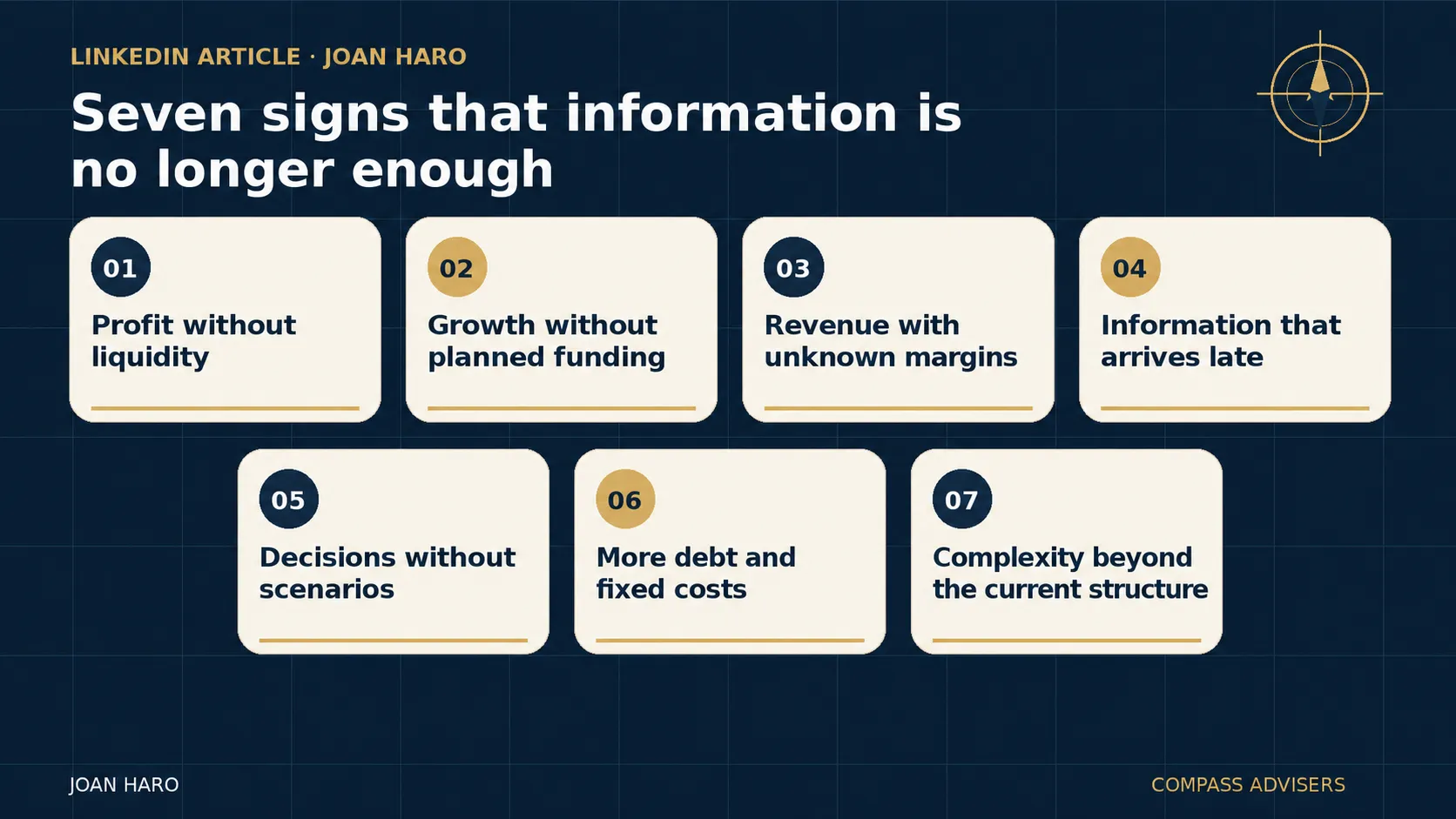
Seven signs that business complexity has outgrown the information available
There is no turnover threshold beyond which a business automatically needs a finance director.
A business starts to need financial management when the complexity of its decisions exceeds what the information it uses to make them can support.
After more than 30 years working with businesses, I have found that this point does not always coincide with rapid growth. It may arise when working capital increases, margins tighten, debt is taken on, new business lines open or management begins making commitments that are difficult to reverse.
Accounting remains essential. The difference is that accurately understanding what has happened is no longer enough. Management needs to understand what is happening, what may happen and what decisions it can make.
There is no magic number
A relatively small business may need financial management if it operates with limited liquidity, tight margins, long collection periods or complex projects. A larger but stable business, with immediate payment and little investment, may operate with a simple finance structure for longer.
The need depends less on size than on complexity, risk and how frequently decisions with an economic impact must be made. In businesses with turnover of between one and ten million euros, this need often arises before a full-time in-house finance director can be justified.
Financial control enables forecasting, comparison and the identification of variances. Financial management goes a step further: it interprets that information, presents alternatives and supports the decision.
Seven signs that a business needs to take the next step
1. There is profit, but not enough liquidity
The income statement shows a profit, but difficulties arise in paying wages, taxes, suppliers or loans. There is no contradiction: profit and cash measure different realities.
Cash flow forecasting helps identify in advance when a shortfall will arise, what causes it and how long it will need to be financed.
2. The business grows without knowing how much money it will need
Growth usually requires hiring, investment, holding more stock or financing customers for longer. Payments come before the return.
If the sales plan is not translated into projected results, a balance sheet and cash flow, the business knows how much it wants to sell, but not how much growth it can finance.
3. Turnover is known, but the real margin is not
Higher sales do not necessarily mean higher earnings. Discounts, inefficiencies, unbilled hours or certain customers can erode margins without the overall result making this clear.
Management needs to know which products, services, projects or customers create value and which consume resources without delivering an adequate return.
4. Information arrives too late to take corrective action
Receiving December's final accounts in April may fulfil obligations, but it is too late to correct a variance that began months earlier.
When decisions are frequent, a business needs reliable monthly closes, updated forecasts and a few indicators linked to specific actions.
5. Important decisions are not supported by scenarios
Business intuition is valuable, but insufficient when a decision is difficult to reverse: hiring, investing, opening a new location, taking on a major customer or assuming new debt.
Scenario analysis does not eliminate uncertainty. It allows it to be quantified and shows what would happen if sales were lower, costs rose or customer payments were delayed.
6. Debt and fixed commitments increase
The greater the loans, rent, wages and other fixed costs, the smaller the margin for error. A business must know its payment capacity, its maturity schedule and the impact of a temporary downturn in activity.
Waiting until cash flow comes under pressure reduces the alternatives and weakens the negotiating position with lenders and suppliers.
7. Complexity outgrows the existing finance structure
The need increases when there are several companies, sites, markets, business lines or managers authorised to spend. It also becomes apparent when banks, shareholders or investors request forecasts that the business cannot explain coherently.
At that point, knowing the combined result is no longer enough. Responsibilities must be assigned, budgets set and the contribution of each part of the business understood.
A practical example
Consider a services business with turnover of two million euros and an annual profit of €150,000.
It wins two contracts that could increase sales by 30%, but must hire staff, buy equipment and take on new costs from the first month. Customers will pay in 90 days.
The historical accounts show that the business is profitable. However, they do not by themselves reveal how much money it will need before receipts begin, what will happen if a customer pays late or the actual margin each contract will deliver.
Financial management turns these questions into projected results, a balance sheet and cash flow, incorporating different scenarios. The conclusion may be that growth is profitable but needs financing for six months. The decision will not be to stop growing, but to prepare for growth before committing resources.
The function matters more than the organisation chart
Needing financial management does not mean immediately hiring a full-time finance director. The function can be organised through an internal management controller, an outsourced finance director or a combination of resources.
The solution depends on complexity, the frequency of decisions and the structure of the business. What matters is that someone takes ongoing responsibility for forecasting, analysis and supporting decisions.
The minimum system
A business that has moved beyond a purely accounting-based approach should have, at a minimum:
- A reliable and timely monthly close.
- A cash flow forecast, with particular attention to the next thirteen weeks.
- A budget and scenarios reviewed throughout the financial year.
- Analysis of margins and variances.
- A dashboard linked to decisions, responsible people and actions.
The real dividing line
The need for financial management does not arise when a business reaches a particular size. It arises when decisions start to have consequences that the available information can no longer anticipate.
Accounting remains the foundation. Financial control identifies variances. Financial management turns that information into alternatives and decisions.
The question is not simply whether the business is large enough. It is whether it can continue making decisions with the information it has.
Which of these signs appeared first in your business?
About the author