Financial management and management control
Making a profit does not mean having cash
Why a profitable business can run short of cash, and how to connect profit, working capital and cash flow forecasting.

Record turnover. A positive income statement. The management team celebrates the company's best financial year. Yet an emergency credit line is needed to pay the next payroll.
In more than 35 years leading finance teams and serving on management committees, I have seen this scene repeated. A business can be profitable and still struggle to pay. One key to understanding this is how it manages the money needed for day-to-day operations: working capital.
The costliest misunderstanding in business management
Profit and cash answer different questions. Profit measures the accounting result for a period. Cash shows the money available and the receipts and payments that change it.
Accounting follows the accrual principle: income and expenses are recognised when the transaction requires, even if cash has not yet been received or paid. That is why a sale can increase profit while payment is still outstanding.
Two concepts that should not be confused
To make decisions, it helps to distinguish net working capital from operating funding requirements. They sound technical, but answer two very practical questions.
Net working capital is current assets minus current liabilities. It also equals the permanent funding —equity and long-term finance— remaining after non-current assets have been financed. It helps explain how much short-term activity is supported by stable funding.
Operating funding requirements, referred to as NOF in Spanish, reflect the resources required for normal business operations. A simple approximation is: trade receivables plus stock, minus trade payables. A full calculation includes other operating items and, depending on the approach used, a minimum cash balance for operations.
Put simply: operating funding requirements show how much money the business cycle needs; net working capital helps show how much is covered by stable resources. If that coverage is insufficient, the difference must be financed or cash released from the cycle itself. No single figure replaces a forecast of receipts and payments.
The time between paying and collecting must also be financed
Imagine a transaction in which goods remain in stock for 45 days. After the sale, the customer takes another 60 days to pay. If the supplier is paid 50 days after purchase, 55 days pass between payment and collection.
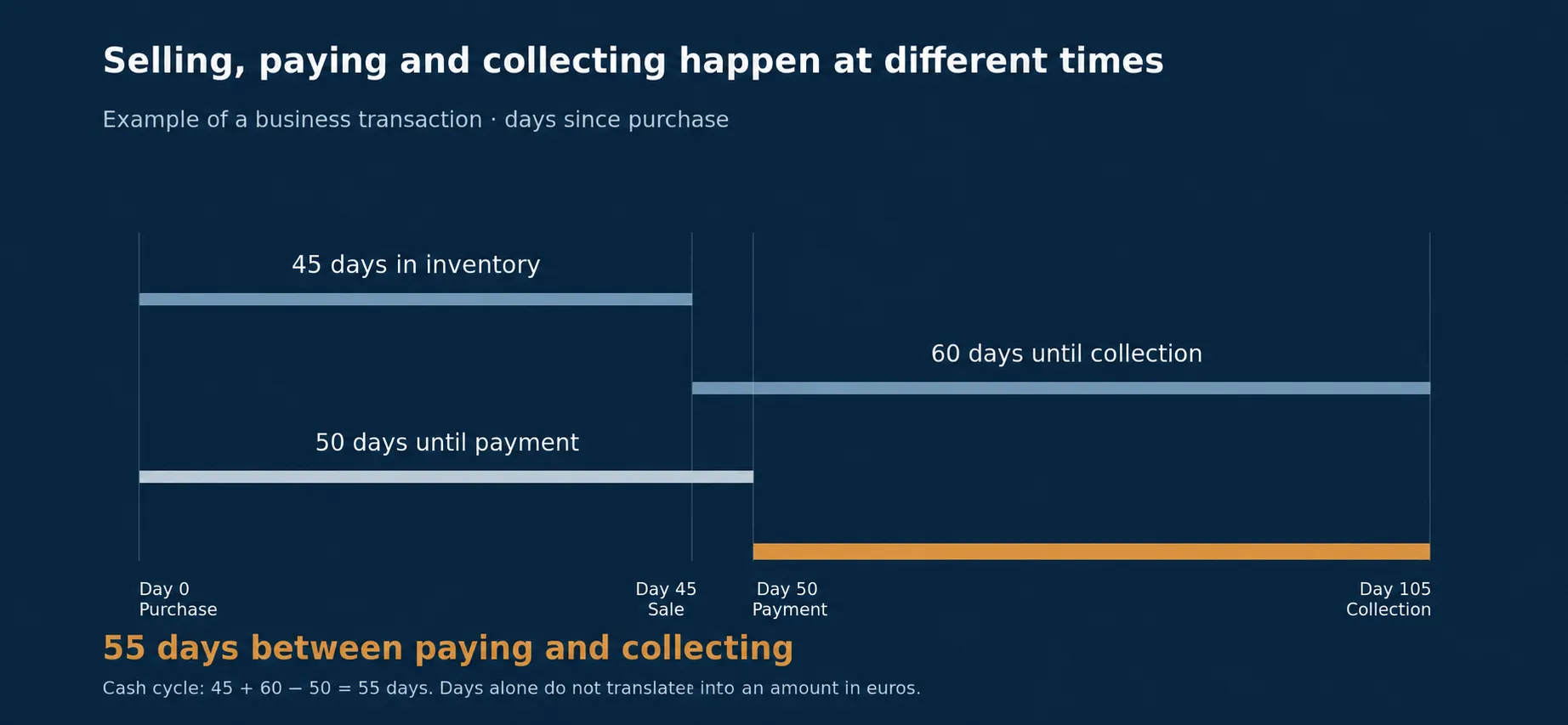
These days help explain the timing gap. To express it in euros, receivables, stock and payables balances must be calculated using their corresponding bases: sales, cost of goods sold and purchases. Multiplying daily sales by the days in the cycle is not enough.
The example: more profit and more money tied up
A business increases sales from €5 million to €6.25 million: growth of 25%. Net profit rises from €400,000.00 to €550,000.00. To see what happens to working capital, assume the following balances at each year-end:
| Item | Year 1 | Year 2 |
|---|---|---|
| Trade receivables | €800,000 | €1,000,000 |
| Stock | €450,000 | €562,500 |
| Less: trade payables | €500,000 | €625,000 |
| Simplified operating funding requirements | €750,000 | €937,500 |
Illustrative example: amounts exclude VAT and other operating items. All three balances are assumed to grow by 25%. These are not the balances derived from the day-based cycle described above.
Growth requires an additional €187,500.00 to remain in the operating cycle. That money is tied up in operations and reduces the cash they could release. This does not mean that the whole amount must be borrowed from a bank: it can be covered by cash generated by the business, available resources or additional financing.
To establish whether cash increases or decreases, the analysis must be completed. Suppose that, in addition to profit of €550,000.00, year 2 includes €100,000.00 of depreciation and amortisation, €350,000.00 of investment paid for and €150,000.00 of loan principal repayments. The result would be:
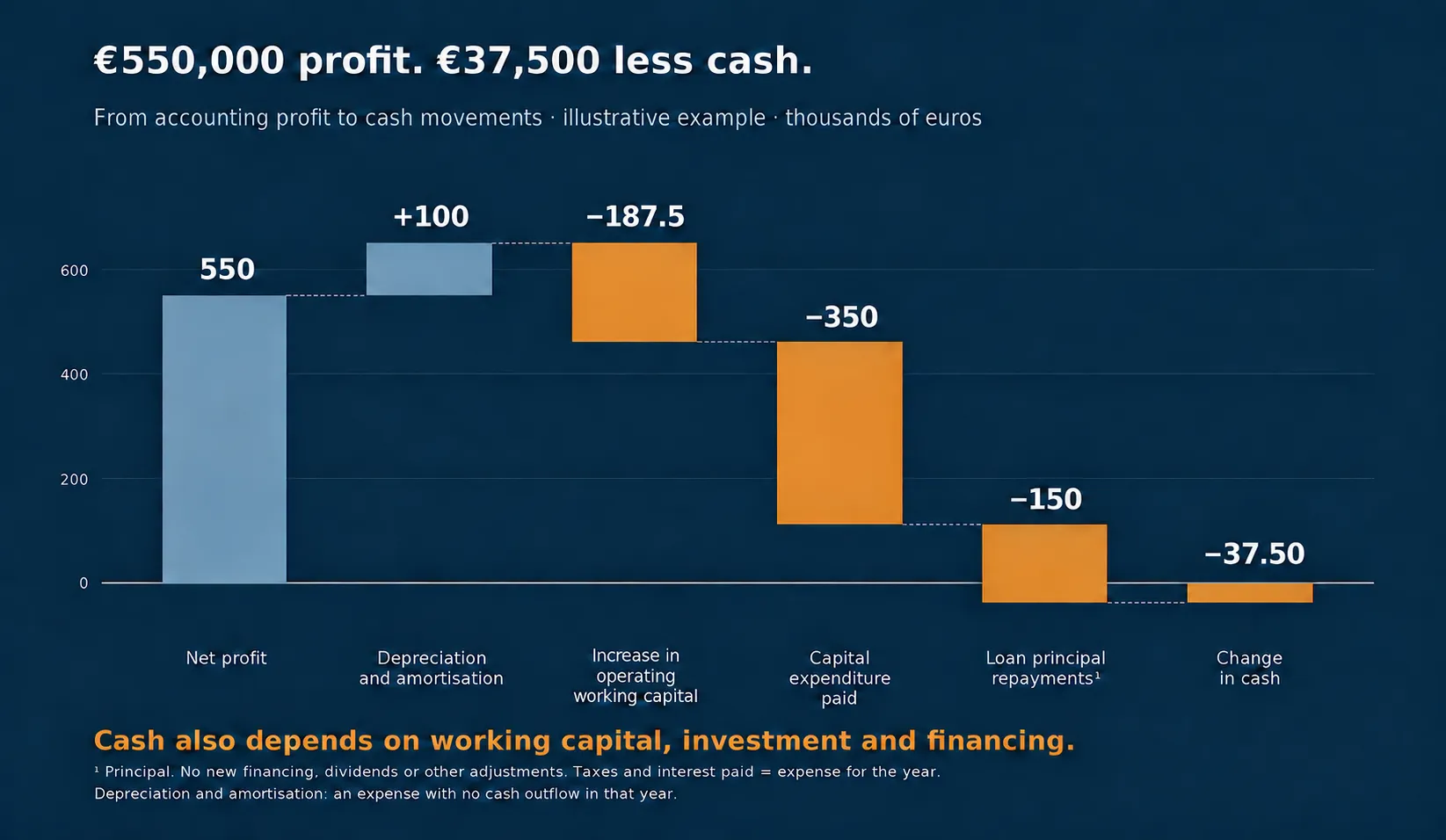
In figures: €550,000 profit + €100,000 depreciation and amortisation − €187,500 increase in operating funding requirements − €350,000 investment − €150,000 loan principal repayments = −€37,500 change in cash.
Depreciation and amortisation are added back because they reduce profit without involving a payment in that financial year. Repaying a loan's principal, by contrast, consumes cash without being an expense in the income statement.
Why growth requires financing to be planned in advance
In this example, the business earns a profit of €550,000.00 and ends the year with €37,500.00 less cash. If it started with €100,000.00, it would finish with €62,500.00. The profit is real; so is the reduction in available cash.
That alone does not show that the business will fail to meet its payments. To establish that, we must look at when payments fall due, what receipts are expected and what financing is available. A positive year-end balance can also conceal pressures during the year.
This is the issue that deserves management's attention: in businesses that collect after paying and need stock, growth usually requires more working capital financing. If sales rise but collection takes longer or stock builds up, the pressure may be even greater.
That is why I insist that an expansion plan must include how growth will be financed and when the money will be needed.
Managing working capital in practice
Managing working capital is not about holding back sales. It is about enabling the business to sustain them. In practice, this means working on five decisions:
- Collect payments consistently. Agree clear terms, invoice on time and address overdue payments and issues before they accumulate.
- Review stock. Distinguish necessary inventory from excess and slow-moving products. All of it ties up money.
- Coordinate payments. Negotiate workable terms with suppliers and comply with applicable and agreed deadlines. Delaying payments without agreement is not a sustainable solution.
- Forecast cash flow. Use a weekly forecast for the next 13 weeks, updated with receipts, payroll, taxes, debt and investments, and linked to the annual plan.
- Decide on financing early. Separate permanent from seasonal needs, check the financing actually available and assign responsibility for improvement measures.
The idea I would like you to take away
Profit helps explain profitability. Cash allows commitments to be met. Financial management must explain both and connect them to growth, investment and financing decisions.
The question is not only how much we will sell or earn. It is also how much money we will need to achieve that, and when it must be available.
If your business is growing and you want to assess whether you have the financial control you need, you can request an initial conversation to identify what should be analysed in more detail.
About the author